
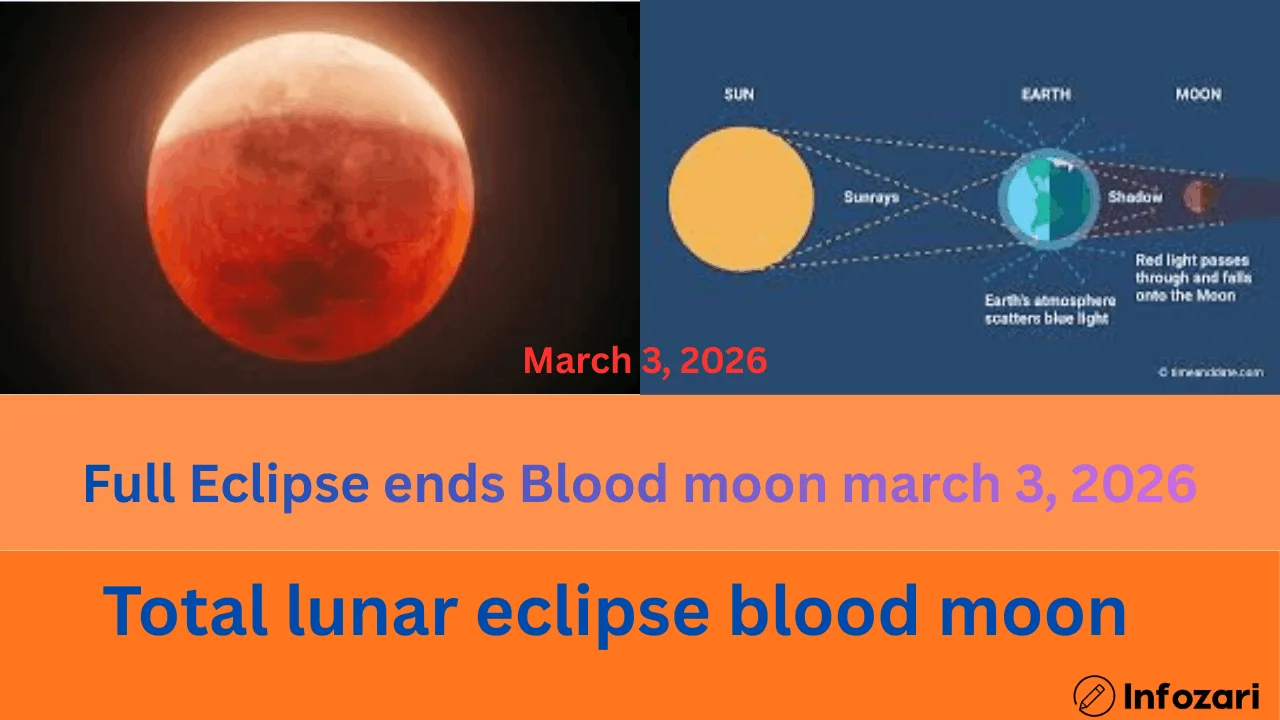
How to see total lunar eclipse blood moon – 2026
A total lunar eclipse blood moon will blush the Moon in the early morning of March 3, 2026.
What’s a total lunar eclipse ?
A total lunar decline happed when the moon pass through the Earth shadow or umbra, its luminous argentine white face a deep orange red. Lunar eclipses only be when the sun, Earth, and moon are aligned at same right the Earth passes directly between to the sun and the moon. its does not be every month because the moon’s route listed.
Lunar declines have numerous phases. Up first is the penumbral decline, when the moon moves into the faint external shadow of the Earth, called the penumbra. During this phase, the moon’s face dims only slightly. Once the moon reaches the umbra, or the thick part of the Earth’s shadow, it becomes a partial decline this is when the coppery red tinge creeps onto the face of the moon, sluggishly consuming the full circle. Once the entire moon is covered by the umbra, the decline becomes a total decline.
An intriguing quip about lunar declines is that they only do during full moons, due to the specific alignment necessary for the miracle. The Sept. 7- 8 total lunar decline will be during the full” sludge” moon, a surname that comes from the Farmer’s Almanac, which names moons grounded on Native American traditions. therefore, September’s moon derives its name from the seasonal sludge crop.
How can I observe the total lunar eclipse blood moon?
You can observe a lunar eclipse without any special outfit. All you need to a line of sight to the blood Moon! For a more dramatic observing experience, seek a dark terrain down from bright lights. Binoculars or a telescope can also showing your view.
On March 3, summation will be visible in the evening from eastern Asia and Australia, throughout the night in the Pacific, and in the early morning in North and Central America and far western South America. The eclipse is partial in central Asia and important of South America. But No eclipse is show in Africa or Europe country.
Why is a lunar decline occasionally called a “ blood Moon ”?
During a total lunar decline, the Moon appears dark red or orange. This is because our earth blocks utmost of the Sun’s light from reaching the Moon, and the light that does reach the lunar outside is filtered through a thick slice of Earth’s atmosphere. It’s as if all of the world’s suns and evenings are projected onto the Moon.
When and where can I see the decline?
utmost of the world’s population will be suitable to see the Sept. 7- 8 total lunar eclipse. observers across Eastern Africa, utmost of Asia, the western half of Australia, and East Antarctica will be suitable to see the wholeness of the eclipse, from the penumbral phase to summation and back again. Regions to the east and west of this zone — including Europe, the rest of Africa, and the rest of Australia — will see at least part of the eclipse. Unfortunately, if you live in the Americas, you are out of luck. The decline will do during daylight hours then, so it will not be visible.
As for timing, summation during the Sept. 7- 8 decline is especially long- lasting — the moon will remain glowered for 82 twinkles — while the whole decline will last nearly 5.5 hours. The below map shares the times of each phase of the eclipse.
| Eclipse Stages Worldwide | Time (UTC) | Local Time in Dhaka | Visible in Dhaka |
| Penumbral Eclipse begins | 3 Mar, 08:44:25 | 3 Mar, 14:44:25 | No, below the horizon |
| Partial Eclipse begins | 3 Mar, 09:50:07 | 3 Mar, 15:50:07 | No, below the horizon |
| Full Eclipse begins | 3 Mar, 11:04:34 | 3 Mar, 17:04:34 | No, below the horizon |
| Maximum Eclipse | 3 Mar, 11:33:46 | 3 Mar, 17:33:46 | No, below the horizon |
| Full Eclipse ends | 3 Mar, 12:02:49 | 3 Mar, 18:02:49 | Yes |
| Partial Eclipse ends | 3 Mar, 13:17:15 | 3 Mar, 19:17:15 | Yes |
| Penumbral Eclipse ends | 3 Mar, 14:23:06 | 3 Mar, 20:23:06 | Yes |



Pingback: ইউরেনিয়াম কি? ইউরেনিয়াম এর অর্ধায়ু কত? ইউরেনিয়াম-২৩৮
Pingback: মহাবিশ্ব কত বড়? সহজ ভাষায় জানুন।