
Applications: Filament yarn is widely used in sportswear, lightweight clothing, hosiery, lining fabrics and many woven and knitted fabrics.
While the knowledge of the various yarn categories is beneficial for textile engineering students, knitting industry experts, garment manufacturers, and those who are fascinated with the fabric production, it is necessary for engineers to understand its various types. There are various ways to categorize yarns but the next 10 are talked about as a result of their structure and use.
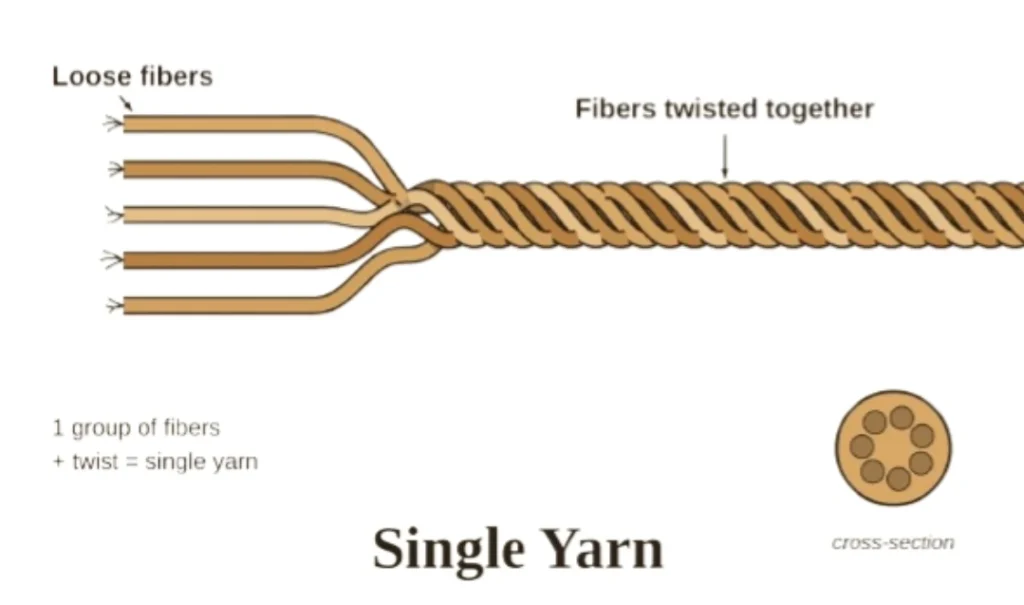
1. Single Yarn
Single yarn is one of the simplest yarn structures. It is made in single strands – either by platting staple fibres together or from a continuous filament.
Single yarns have properties that vary by raw material, yarn count, yarn twist, and production processes. Small fibre ends may occasionally be seen in the surface of the staple fibre yarns, resulting in a slightly hairy look.
Applications: Single yarn is widely applied for weaving, knitting and other yarn structures. The properties depend on whether it is from cotton, polyester or another material.
2. Ply Yarn
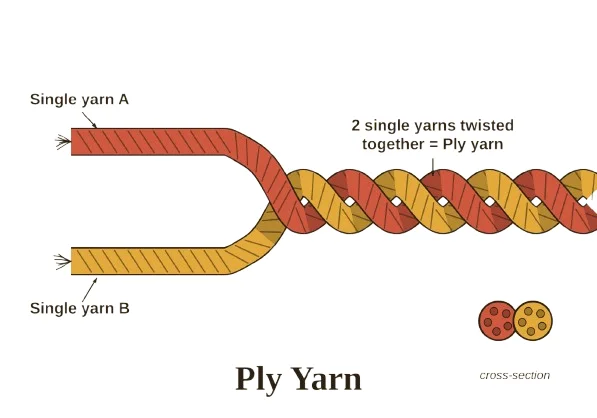
Ply Yarn: This is formed by twisting together two or more single yarns. Depending on its construction, this may result in a combination structure that could yield advantages in strength, balance, and durability as compared with an individual yarn.
Not all ply yarn is necessarily a thicker yarn, depending on how many and how many-ply they are. Manufacturers choose the right choice of ply structure based on the specifications of the final product.
Applications: Sewing threads, knitted products, woven fabrics, and other textile materials with special strength or characteristic required.
3. Cord Yarn
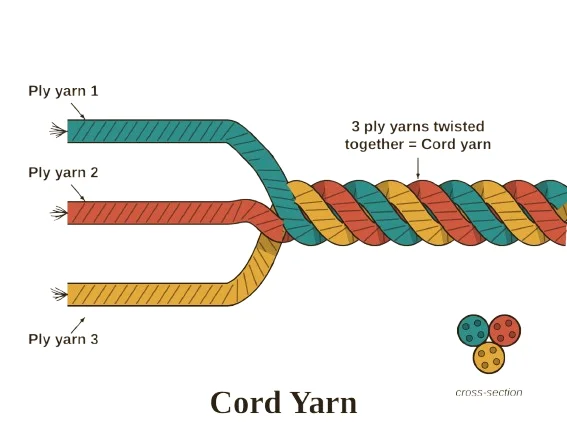
Usually, cord yarns are made of two or more twined yarns. The extra twisting result in a tougher, smaller unit for uses in which strength matters.
Final properties are dependent on the same factors as well as yarn constituents, twist properties and manufacturing methods. Cord yarn is usually thicker than other ordinary yarns and meant to resist tough situations.
Applications: Cord yarn is employed for different products wherever robust load bearing worth is essential such as cord, rope, industrial cloth and reinforcement materials.
4. Filament Yarn
Filament yarn is made from a single or two or more long continuous fibers. Staple fibres are shorter than filament fibres which are continuous along the yarn.
The surface of filament yarns is smooth and they have relatively low hairiness. The appearance and performance of these depends on the filament type, number of filaments, and if the yarn has been subjected to other processes or not.
Synthetic Filament Yarns are made out of materials such as polyester or nylon. Natural fibre examples of a continuous filament fibre include silk.
Applications: Filament yarn is widely used in sportswear, lightweight clothing, hosiery, lining fabrics and many woven and knitted fabrics.

5. Spun Yarn
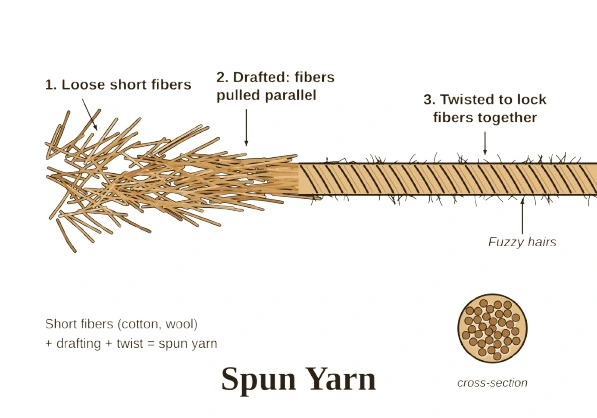
Spun yarn is yarns produced by drafting and twisting short fibers to join them together. The raw material used for the manufacturing of this type of yarn is usually cotton, wool, or staple polyester.
Spun yarns are made from fibres of a restricted length, so that some fibre ends are free to stick out from the yarn. Can create a soft, natural look in a yarn that is not as smooth as some filament yarns.
But the actual softness, strength and hairiness of it rely upon the quality of fibre, spinning technology, yarn count and twist.
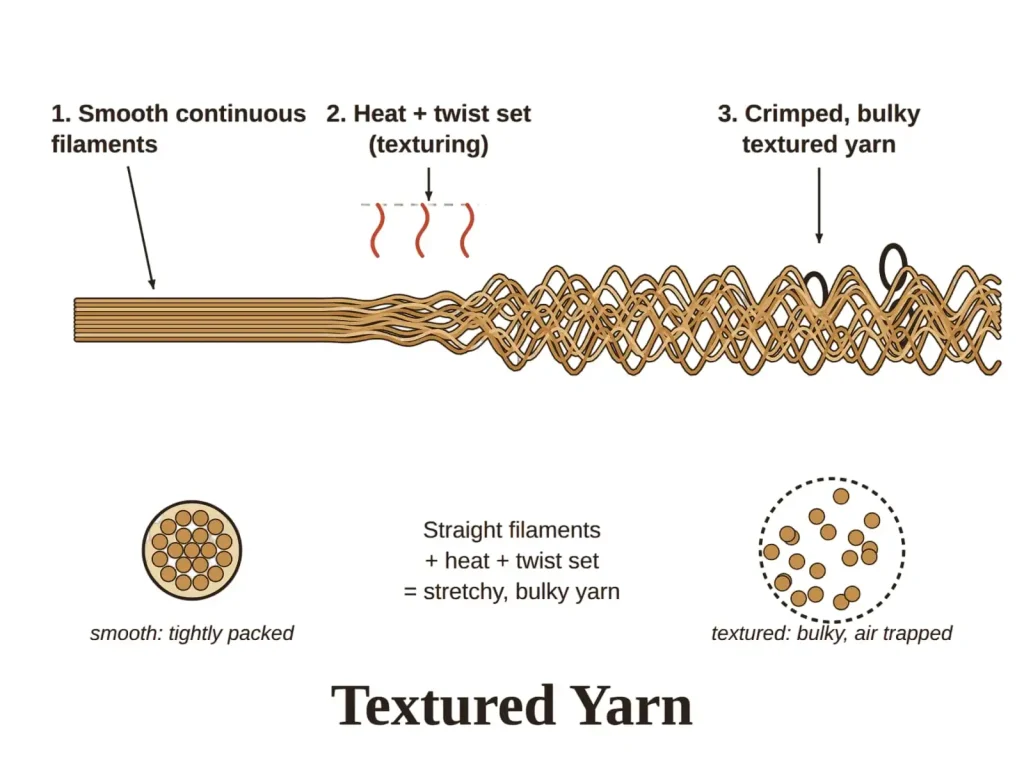
6. Textured Yarn
Any synthetic filament yarn produced that is crimped, looped or otherwise given bulk is generally referred to as textured yarn. This transform the actual nature of the yarn and can boost its stretch, cover, as well as softness.
Textured yarn is not a plain filament as with a normal yarn but could be fuller and flexible. The various texturing methods yield different amounts of elasticity, bulk and surface quality.
Textured yarns are often made out of polyester or nylon.
Applications: Sportswear is one very common use for textured yarn; some other common uses include stretch fabrics, hosiery, ac
7. Core-Spun Yarn
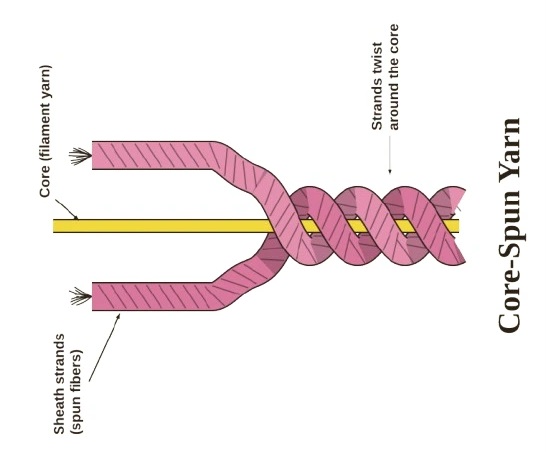
Core-spun yarn is made from a central spun yarn which is combined with an outer covering of staple fibres. The covering is usually a single fibre though it can vary to cotton or polyester or another more suitable fibre, with the core being a continuous filament.
The ability to combine the properties of different materials is achieved in this construction. For instance, the outer layer could form a normal textile look while the inner would be elastic to provide stretch.
The performance shall be influenced by the core material (including fibre) and spinning conditions.
Applications: With its uses in sewing threads, stretch denim applications, elastic textile products, and special garment manufacturing, core-spun yarn is widely applied.
8. Slub Yarn
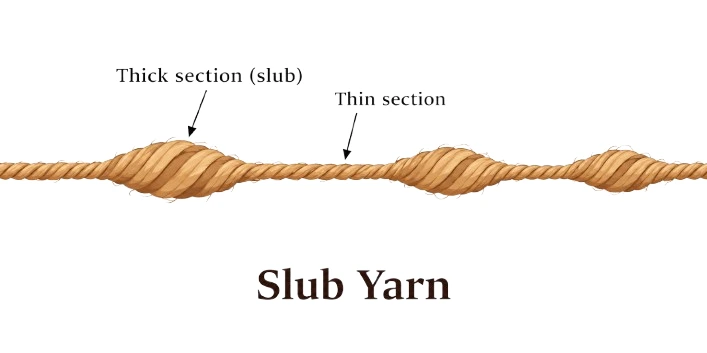
Slub yarns generally have intentional thickness irregularities along their entire length. Some of the areas are thicker than the rest, making them irregular.
Such diversions can be made in the spinning process or by special modifications of the spinning operation. A slub is not an accidental fault, it is a deliberate one meant to give the yarn a certain appearance.
The effect of the input fabrics depends on the size, frequency and distribution of the slubs.
Applications: Slub yarn is widely popular for use in denim, casual shirts, T-shirts, light-weight knitwear and in fashion textiles where there is a requirement for a textured or slightly uneven effect.
9. Siro-Spun yarn
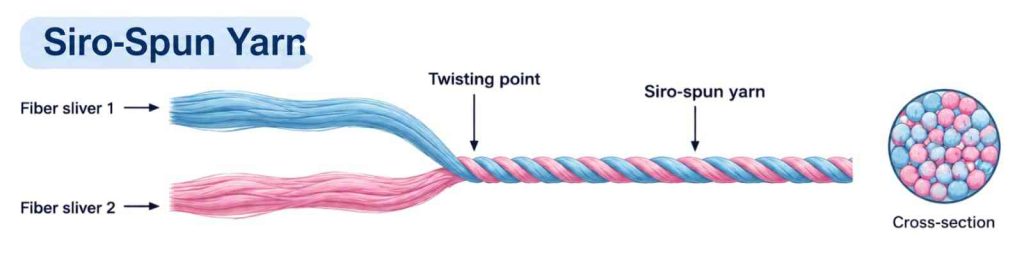
Siro spun yarn was created by spinning two separate fibre strands, normally known as rovings, through a spinning system. Drafted on their own and then gathered together near the twist-point to make a combined Yarn structure.
This technique may yield a yarn having less surface hairiness than some ring spun yarns and good fibre cohesion. The actual output will vary depending on the type of fibre used, machine settings and production parameters.
The spinning method of Siro can be very useful in situations where smooth yarn surface and an appropriate fabric colour and look are desired.
Type: Siro-spun is suitable for woven fabrics that require surface quality and performance of the yarns such as shirting, suiting and denim.
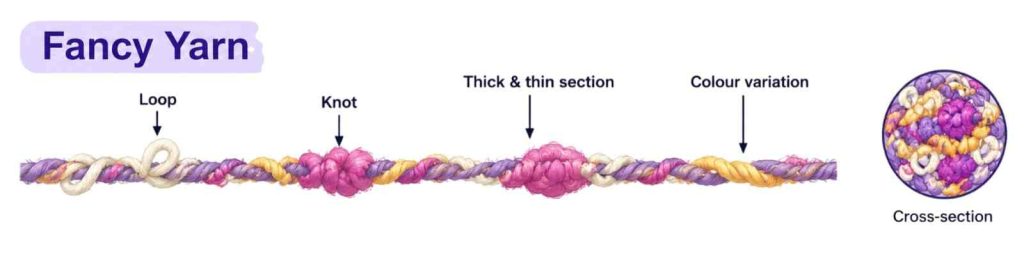
10. Fancy yarn
Fancy yarns are a general term for yarns that have been designed to produce a unique appearance or effect on the yarn. This can include loops and/or knots, thick and thin sections, colour variations and any mixture of fibres.
Although the primary purpose of fancy yarns is generally for decorative purposes, they differ from regular yarns in that they are not always uniform but rather primarily aesthetic. There are many different kinds of structures, each with a different strength, softness and quality, depending on the structure’s design.
A few fancy yarns are manufactured in a special method of spinning or twisting, and some fancy yarns are made with a blend of yarns together to form a special effect.
Applications: Fancy yarn is utilized in sweaters, scarves, stylish articles of clothing, funky textiles, home textiles and upholstery.
What are you able to choose the right yarn?
The first step in choosing the right yarn is to determine what you want to use it for and what types of fabrics you’re going to make. The best yarn for a t-shirt might not be ideal for a sweater or industrial-reinforcement application.
These are some of the things you should think about when selecting a yarn:
Fibre make: Cotton, polyester, nylon, blended fibre and woolen fibres have their own properties.
Yarn structure: Single, ply, cord and core spun affects strength, look and performance.
Surface properties: Hairiness, smoothness, bulk and texture are surface properties that impact on the appearance and feel of the fabric.
Stretch and recovery: Yarns with texture and elastic core can be beneficial when flexibility is needed.
The application fields are very different such as sewing thread, denim, sportswear, upholstery and technical textiles.
Processing (spinning method, twist, yarn count, finishing) has a great influence on the final product.
Conclusion
The 10 yarn types mentioned above illustrate that different types of yarns with varied production methods affect the performance of the textiles made using such yarns. Single yarns offer other constructions, ply yarns offer other constructions, filament yarns offer different fibre forms to spun yarns, textured, slub and fancy yarns offer different surface effects compared to other yarns. For some uses there are construction options available with core spun, cord, and Siro spun yarns.
Textiles professionals find it useful for choosing the proper raw materials, developing better textile, and matching the properties of the textiles to the production requirements. Ultimately, the yarn used will be determined by the fabric design, fabric production, and final use in the production of the finished textile product.
Pingback: Cotton Yarn Price Trend: Market Analysis, Factors & Future Outlook